Animals and an elderly cohort
Maximum lifespan, mean lifespan and mortality
The scale expands from cultured cells to whole lives. The endpoints become harder to compress.
Female Swiss-derived SHR mice
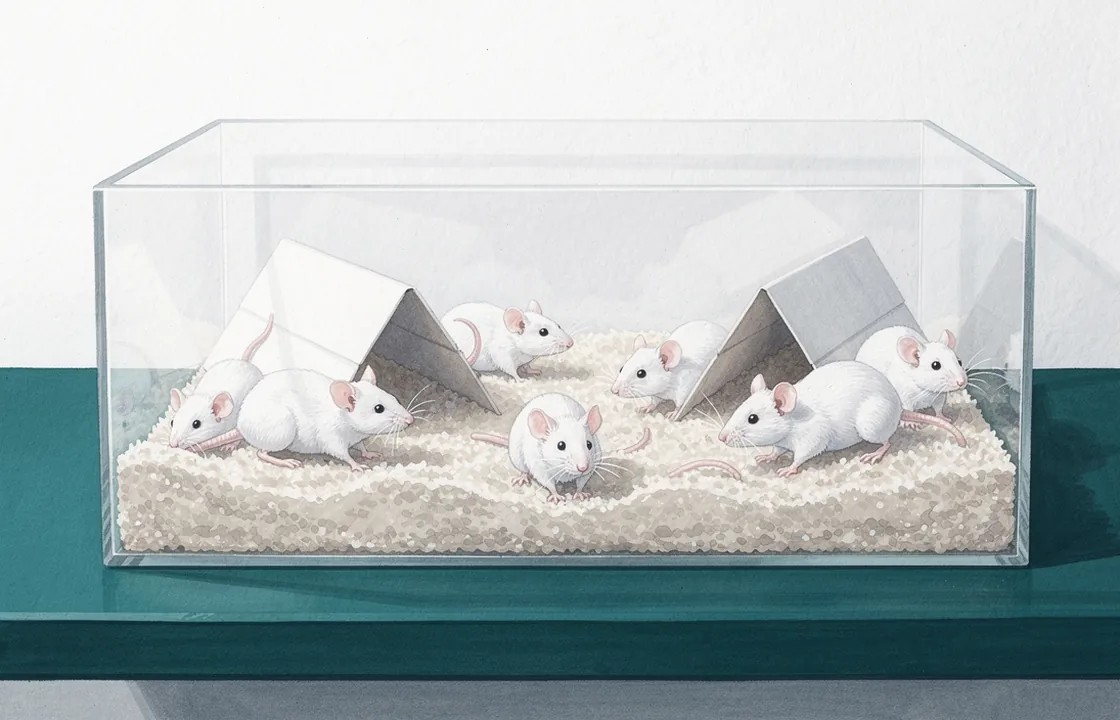
In a study of female outbred Swiss-derived SHR mice, Epitalon increased maximum lifespan by 12.3%, while mean lifespan was unchanged. Total tumour incidence was unchanged, and leukemia was inhibited.
The maximum-lifespan result first sounded decisive. Then the unchanged mean interrupted my optimism. An improvement at the longest-lived end of a group and an improvement in its average describe different achievements. The paper reports the former alongside the unchanged latter.
That is enough to make the study interesting, and too particular to turn into a general statement that everyone lived longer. The animals were female mice of the specified stock. No human lifespan increment follows from the percentage.
The human Epithalamin follow-up
A 6-8 year observational study of 266 elderly persons associated Epithalamin, alone and combined with thymalin, with reduced mortality compared with untreated controls. The preparation was Epithalamin, and the study was observational, without randomization or a placebo control.
For me, the preparation's identity has to come before the mortality claim. The human follow-up cannot silently become a trial of Epitalon because the names look related. Nor can an association settle what caused the difference between groups.
The mouse experiment and the elderly cohort therefore remain separate accounts: different preparations, different subjects and different kinds of comparison. Their proximity on a reading list supplies no missing clinical experiment.
Returning to the smaller experiments
The Epitalon review describes a range of proposed actions and also records limited physical, chemical and structural characterization. I think the range invites more discrimination about the outcome being claimed. A longer maximum lifespan, a mortality association and a cultured cell's quality each need a different account.
The mouse-oocyte experiment remains the most evocative to me. It supplies a manageable question about cell quality under a particular experimental difficulty. Elysian can accommodate that smaller hope without pretending it has answered how long a person will live.